
Braided Ecology
Who We Become Inside the Worlds that Shapes Us.

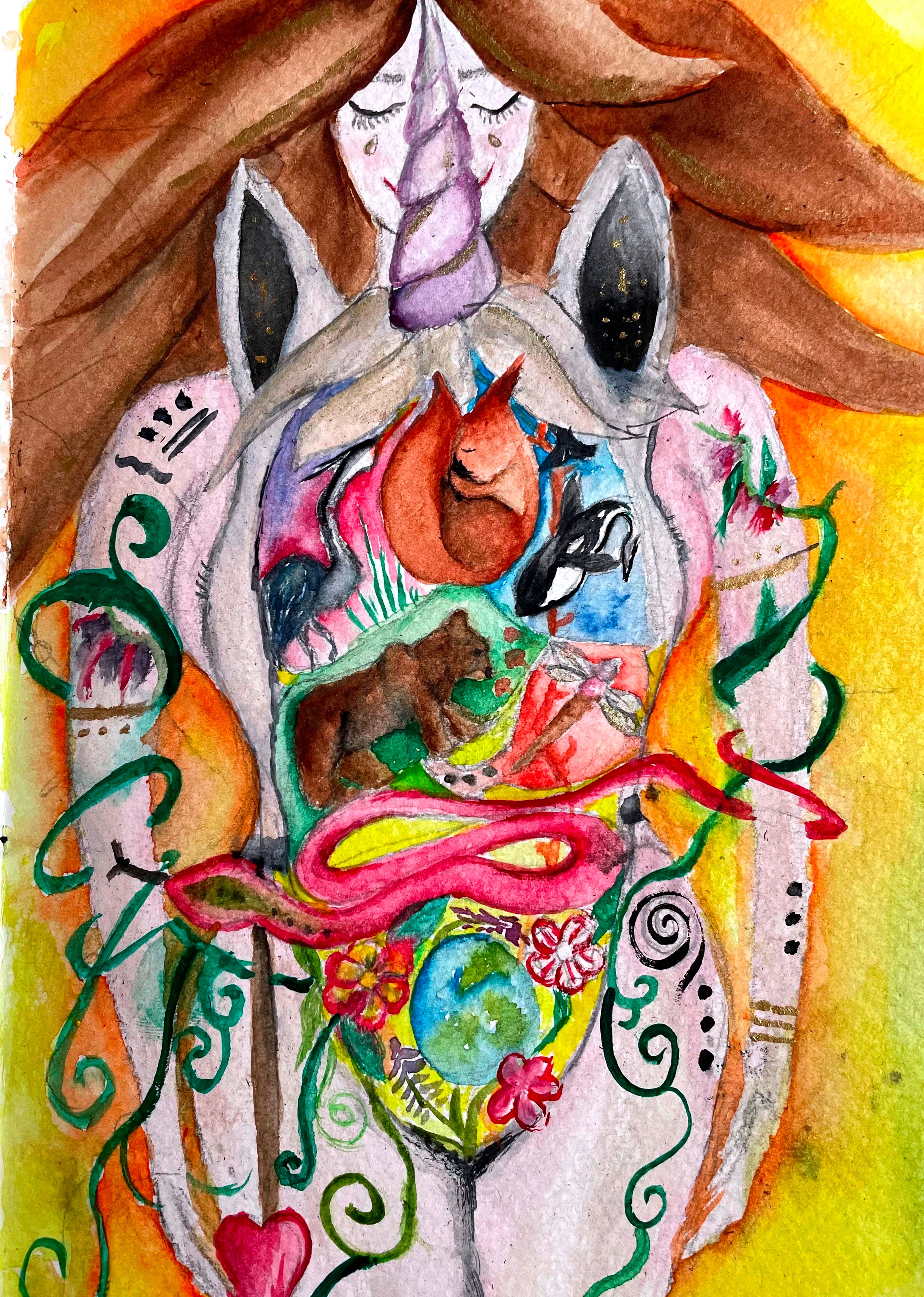
I have been sitting with the idea of braided ecology, the truth that none of us are shaped by a single thread, but by many lives woven together inside us.
Not just our personality, our wounds or our brilliance, but the entire ecology we grew inside. And by that I mean our nervous systems, class backgrounds, cultures and mythologies, our trauma lineages.
And further expanding that into the land that held us, or didn’t, pressures that shaped us. The protections we received, or learned to live without and those losses we were asked to metabolise far too young, without the structures to hold us,
All of it braids itself into the body.
When we look at ourselves in this way we notice that we are not individuals floating in isolation but ecosystems in motion, carrying weather patterns that began long before us.
When we look at a person through a single lens, neurodivergent, traumatised, anxious, working class, sensitive, too much, not enough we begin flatten something vast. We reduce a living landscape into a label. We miss the soil conditions, forgot the climate. We overlook predators, the absences, the overcrowding, the droughts, the storms.
And right there we miss the entire ecosystem that made us
When I look at Neurodivergence, for example, it is not just wiring. To me it feels like a body evolved for deep sensing, living inside a world that overwhelms it.
Almost like a tracker without a forest, a watcher without silence or a pattern-reader inside an economy of speed, noise, and extraction. When a nervous system evolved for subtlety is placed inside constant stimulation, pressure, and artificial urgency, it doesn’t fail, it adapts. Sometimes by withdrawing, sometimes by hyperfocusing or burning out, sometimes by fragmenting attention in self-protection.
The problem is not the sensitivity. The problem is the habitat society has created.
Class, too, is not just money. It is a nervous system inheritance. The imprint of scarcity, grit, vigilance, and emotional self-reliance learned too early. The quiet ache of rooms you were taught, subtly or overtly, you didn’t belong in. The learned ability to read atmospheres quickly. The unspoken rule is not to need too much, ask too loudly, or take up unnecessary space. Class lives in the shoulders, the jaw, the breath. It shapes how easily we rest, how safe it feels to receive, how much joy we permit ourselves without guilt.
It is not just an economic category , it is an embodied memory.
Trauma, likewise, is not just memory. It is not simply something that happened to us. Trauma is what occurs when an environment is too much, too fast, too unpredictable for the body to process at the time. It is what happens when the prey body has no resolution , no shelter, no witness, no chance to complete its cycle. It is not a weakness but an unfinished protection.
The body did exactly what it needed to do to survive an impossible ecology. Freeze, fawn, flee, fight, fragment, these are not pathologies, but ancient intelligences responding to threat without support.
And sensitivity? Sensitivity is not a flaw. It feels to me like an ecological role that lost its habitat. In another world, another village, another rhythm of life you might have been the seer, the dream carrier, the quiet genius whose job was to notice what others missed. You might have been essential.
Instead, many sensitive bodies learned to shrink, harden, numb, or perform in order to survive environments that had no place for slowness, attunement, or depth.
Braided ecology, for me, names this truth. The one that says who we are cannot be separated from the worlds we survived, or the ones we were never given. It invites a radical shift, away from pathologizing the individual and towards curiosity about the habitat.
It move us to Not What is wrong with me?
But instead asks us to consider:
What ecosystem shaped this body?
What pressures formed these patterns?
What was I adapting to?
What intelligence was I protecting?
What did my nervous system need that it did not receive?
What environment would finally allow me to breathe?
And perhaps most tenderly:
What kind of habitat is my body longing for now?
And yet, many of us have been offered spiritual frameworks that ask us to separate ourselves from the very ecologies that shape us. Modern spirituality often promises relief through transcendence. It tells us rise above the body, detach from story, outgrow identity and to vibrate higher, think positively and dissolve the past. For some nervous systems, this has offered real refuge. When the body was once unsafe, leaving it , even conceptually , can feel like mercy and dissociation, when framed as enlightenment, can feel like a temporary life raft.
So I want to name this gently, not all transcendence is harmful, but unrooted transcendence is. When spirituality asks us to bypass the body, it often bypasses braided ecology itself. the classed body, the traumatised body, the sensitive body, the neurodivergent body, the ancestral body.
It is here pain becomes illusion rather than information and adaptation becomes failure rather than intelligence. Nervous system responses become something to “outgrow” instead of something that once kept us alive. Trauma is reframed as a mindset, class becomes a limiting belief and sensitivity becomes a vibration problem.
And without meaning to, spirituality can become another pressure, another place where the body must perform wellness, softness, positivity, or transcendence in order to belong.
In braided ecology terms, this is like asking a plant to bloom without soil.
I find myself wondering whether healing is really about fixing ourselves , or whether it is about finding, remembering, or building environments where our unique design makes sense. Places where the nervous system can soften, where we can exhale. Places where our own unique sensitivity becomes intelligence again and survival strategies are no longer required to hold the structure of our lives.
Places that feel like ecological belonging rather than constant adaptation.
This inquiry has been deeply delicious to explore within myself , tracing the threads, noticing where I adapted brilliantly, where I hardened, where I learned to disappear, and where something wild and intelligent is still waiting for the right conditions to unfurl.
I am left not with answers, but with a gentler, more spacious question:
Do we heal by changing ourselves, or by changing the worlds we place our bodies inside?
And I’m curious, if you pause and listen closely, what threads make up your braided ecology?
Starting to understand my neurodivergent ways has been an amazing journey. But not an easy one.
But here’s a thing. I’m the database for obscure bits of knowledge. One of those being that ADHD people were really well suited to be great hunter gatherers. Our inattention leaving the harder to gather fruit to their own devices. So that natural propagation can occur. Our hyperfocus able to pay close attention for tracking and hunting. Our sensitivity able to see subtle signs to help this task.
This modern world is definitely not designed to leave me feeling supported and safe. An observation is that I feel that safe and secure people don’t make great consumers (or easily compliant employees), so maybe it has been designed that way. And it’s certainly not designed for me to live a life that is aligned with who I am.
I love the idea of seeing all that formed me as ecology. The lessons from the hard times, as important as the lessons from the easier times. The growl of rage or fear, a song to sing. I’m losing my thread now, but thank you.
Thank you sharing this! Having just received a diagnosis, you've helped to put into words what I was feeling. Hearing the diagnosis made me feel 'flat', like, 'there is more to me than that!'. I am off to ponder on my personal ecology, I'm sensing the exploration will bring the nurturing I've been seeking <3